Showing posts with label painting. Show all posts

Sunday, January 25, 2015

When life gives you yard waste

Add fire.  Always.


BUT... if you are careful, you can extract something useful, too.

Fire, as we view it, is a chemical reaction.  We are watching the products of a combustion reaction beautifully expand to illuminate and warm whatever we chuck next to them, be it marshmallows or a piston engine.  Oxygen is essential to get this reaction to go and so, if you limit the amount of air that gets to your yard waste (carbon rich fuel), you get an incomplete reaction.  There is still plenty left to burn on another fire... so, you have charcoal.

Now, you are playing roulette with your health if you use yard waste to make charcoal for cooking; there are some potentially lethal chemicals in the plants about your yard.  Additionally, these 'charcoal' bits are hardly the ingots we need to feed a fire with any degree of cleanliness or practicality.  Being useless for everyday survival, it seems like we are talking about art now.  Funny how that worked itself out...

Enter, wisteria trimmings:


Most of these vines are small, so they will make charcoal sticks that are far too fragile to draw with.  These small ones will be pulverized and used as pigment (more on that later).  Only big sticks will be kept for drawing charcoal.  It should be noted that wisteria is traditional as a drawing charcoal source.  The other common one is grape vines.  But I tend towards decorative and not useful plants, so there you go.  Did I mention that it is almost February and I am only now getting around to autumn pruning?


1. wisteria (or grape) vines
2. pruners/cutty thing
3. metal can with top lid removed
4. aluminium foil
5. fire source of your choice (more below) 


Cut your vines down to lengths that can fit into your can, then pack them in.


Use the foil to tightly cover the can on the top and sides.  Remember, you are trying to have a smothered fire going, an incomplete combustion reaction because of limited oxygen.  Some oxygen still needs to be there, so do not enclose the can.  Water vapor and other gas needs to escape, too.


Not the most glamorous angle, but, life is tough when you are a can.


I am using charcoal briquettes, lit to keep a flame, in a Weber kettle for my fire source.  Plus, I needed to cook something.  It should be noted that you really are not looking to add meaty-goodness into your drawing materials, so keep anything that will drip juices well away.


So, the can is going to sit in the fire (I am keeping the vents open on the top of the kettle) for about ten hours.  Basically, I let it sit over night, let the fire burn out, and then went to get it the next morning.

I'd say it's past medium-rare:


Peel back the foil and see the finished charcoal.


Yay!  Incomplete combustion!!  If more oxygen had weaseled in there, you would be left with white ash and not that iridescent black.

There still is ash and bits of sloughed-off bark in the bottom of the can.  Dump out the finished charcoal and pick out the useful bits.


Not bad for yard waste, no?


Now, all of the small vines will break when you draw with them.  So, put those aside for another project.  You have made pigment, suitable for paint emulsions and other mediums.  It is closest to Lamp Black in coloring and origin, but I feel like it deserves a more festive name which gives due reverence to the grilled chicken.  Any ideas?

Friday, August 10, 2012

Making Paint


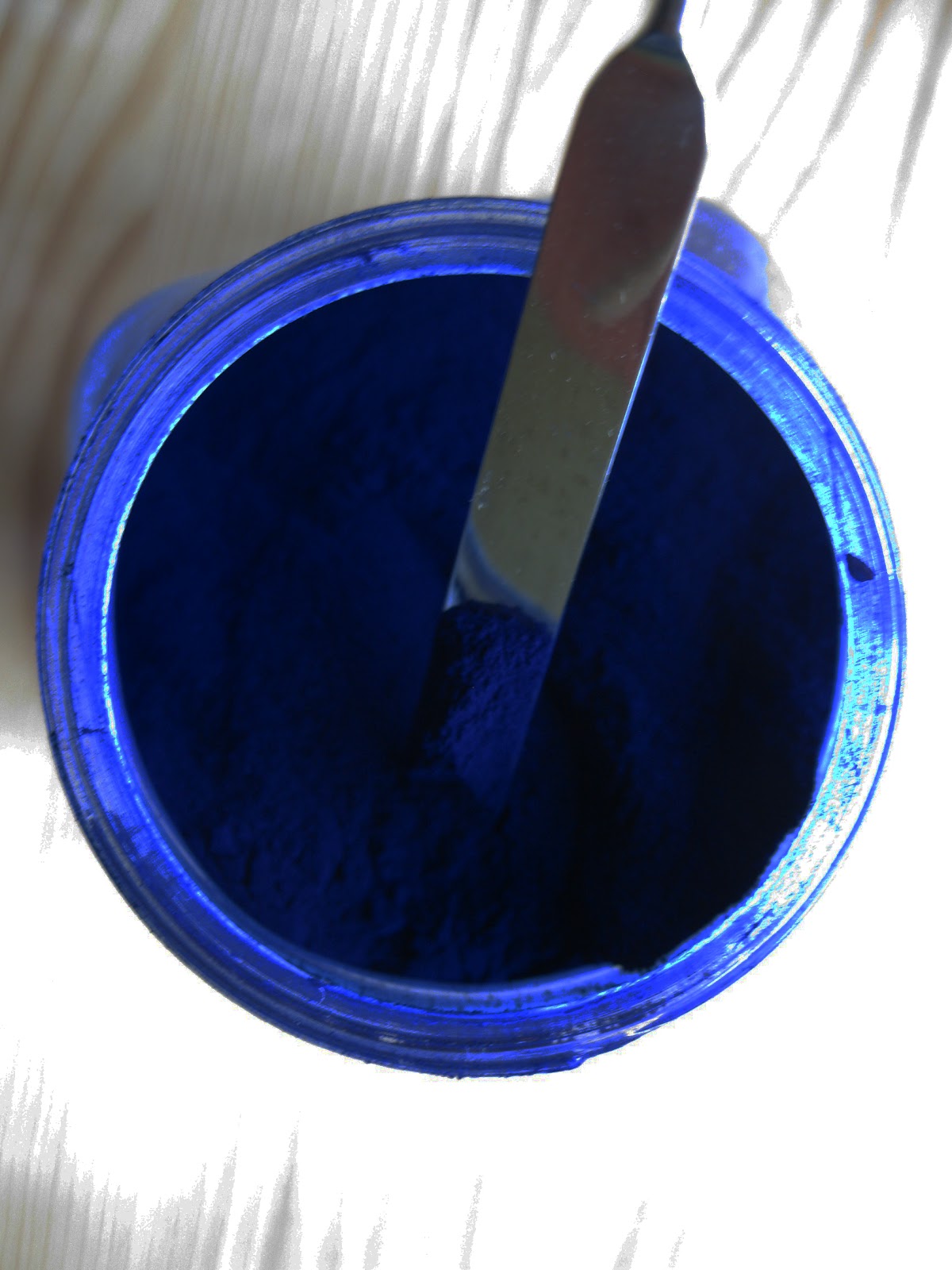
Let's keep this simple.  Paint is just two things, pigment and medium.  You buy pigment (unless hard rock mining is your scene) and then you mix it into your medium.  Well, pulverize it for the best results.


1. Pigment
2. Medium
3. Muller
4. Glass plate
5. Micro spatula
6. Paint brush (optional)
7. Razor/bench scraper/ceramic spatula (optional but HIGHLY recommended)
8. Containers for finished paint (unless you are using it all immediately)


This is a muller.  It is made of blown glass and it has a 'rough' bottom to grind your pigments into your medium.  The more you grind, the more buttery the texture and in some circumstances, the more brilliant the color.  You want to grind on a glass plate because it is a smooth, non-porous, non-reactive surface.


Before you get started, remember, almost every pigment is a heavy metal and it will eventually kill you.  Do not inhale and do not ingest.  So do this in a well ventilated area (wearing a mask is ideal), do not do this on a surface where you will EVER be eating off of, and wear gloves or be super paranoid not to touch the raw pigment.  Seriously.


Alright, now that I have killed off all excitement, let's get started!


There is a recipe for each medium and a ratio for how much medium goes with how much paint.  Since this is a recipe, it calls for a cookbook.  Even if you come up with your own mixture, you should start with a proven method, just to help you troubleshoot any technical issues.  The best book that I have ever come across is The Painters Handbook (see footnotes).  Before I start grinding with the muller, I do a quick mixing (just to eliminate loose pigment) with the micro spatula.


I tend to use/make water based paints because they dry faster, thus allowing me to get in more detail in less time and manipulate older paint layers (unless it is egg tempera, but that is another post).  My basic medium that I make up is for watercolor.  For this, I use a mixture of gum arabic, honey, glycerine, water, and a small amount of thymol, which is an anti-fungal.  Just remember that you are making something which can rot, so some sort of preservative will keep your paint from molding or fermenting.  You can use other things, like clove oil, but I use thymol because I already had it to add to my wheat paste when I cook it.  When I want to make gouache, I just add in some Calcium carbonate to my watercolor medium.


While there is going to be a prescribed ratio of pigment to paint, you can play around with this, too.  You want to make something smooth and buttery with the consistency of clotted cream.... or instant pudding.  No judgements...


Now put your paint into a container.  Got it?  You have paint!  I would also point out that if you start pricing out the cost per volume on your paint, it is about 4x cheaper than the bought stuff.  Unless, you are buying junk, but then, really, why bother.

I hope this is a good starting point for you!


When making paint, try to do it 'right' the first time and then come up with your own house blend on the next batch.  I like The Painter's Handbook by Mark Gottsegen because it also explains the 'why' of what you are doing and what exactly each ingredient is doing:


Tuesday, August 7, 2012

Que Sera, Seurat

I feel bad saying it, I'm sure that some people will suck in their breath over it, but I don't care for Georges Seurat's paintings.  Now, I adore his black and white drawings, but I really don't think very highly of his paintings.


This is the corner shot from the previous post on decorating and, if you look to the upper left, you will see a drawing.


This is a quick copy I did of a Seurat sketch for a study assignment in college.  It isn't the best photograph, shot through glass and edited to reduce glare, and it isn't the best copy (done in an hour starting at midnight in the tradition of art school homework).  Still, I admire the heck out of Seurat's drawings.  They are all moody, sensitive, emotive, and compositionally exquisite.


So why am I hating on his paintings?  Well, I would like to point out that I am not the only one to hate on them.  In fact, Renoir and Monet would not show with him and Pissarro, who initially supported the 'philosophy' that Seurat's work embodied, grew to dislike it.  The reasoning for this dislike is, simply put, his painting are not paintings.  At best, they are depictions with paint.  Just a misuse of the medium.  For a painter's painter, it is an insult to the craft (for what it is worth, I am not a painter's painter either).  I think Seurat made his pieces as paintings because he 'had to' for them to be 'finished' pieces of art in its most elevated form.  Honestly, if you get a bunch of 2D artists in a room, open up a few bottles of wine, fast-forward an hour or so, and it will be very clear that for them, painting (and only oil painting) is tiered above drawing, printmaking, and really just everything.  So I don't think that Seurat would have felt comfortable on a professional, Academically trained level, to have a finished masterpiece as anything but an oil painting.


I think this is too bad.  His work is all about the color relationships.  He coined it Chromoluminarism, also called Divisionism.  Pointillism is the technique he used to show the effects that these pure, little bits of color had when they were next to each other.  For Seurat, art was all about the connotative result of certain colors combined with the literal perceived color for the viewer.  His art was entirely wrapped up in the new ideas of human perception and budding color theory.  These contrasting dots of color would add up at a distance.  If you think about it, this should sound an awful lot like the applications of color in printmaking (of course, exactly like dot-matrix printing but that isn't of historical relevance).   But seriously, wouldn't it have made a killer print?


So you would think that Seurat would at least take advantage of his choice in mediums and capitalize on the characteristics of paint.  But no, the surface of his canvas is flat.  I admit, I pulled a Cameron Frye when I was in front of La Grande Jatte.  You know what?  There was no body to the paint, no lovely surface.  And that is what I personally don't like.  While I am neutral to the subject matter and stylized figures, the lifeless paint just reduces everything to an image.  It just seems like a missed opportunity.  There is something frustrating when you are looking at art which is all ideology.  I wonder if Seurat even had fun making them, or was it all just cerebral?  I think the soul is lost from his beautiful drawings.  It is crazy to think that these black and whites had less rules and structure thrust upon them than these paintings with their vivid colors.

But this is just my take.  I am sure others will disagree.  At the end of the day, Georges Seurat left a legacy and opened doors for new thinking.  I just hope he got some joy out of his work as he went.


Image notes:
The top sketch is my copy of Seurat's sketch of a nude model, done in conte.  The top painting is The Bathers at Asnieres, the next is a detail from Parade de Cirque, and the bottom painting is the famous Sunday Afternoon on the Island of La Grande Jatte.  All images are public domain in the US (US-1923).

Didn't get your fill on the fabulous, technicolor pit of color theory and Seurat?
http://en.wikipedia.org/wiki/Georges_Seurat
http://en.wikipedia.org/wiki/Pointillism
http://en.wikipedia.org/wiki/Divisionism
There, now your mind should be reduced to putty... colorful, colorful putty.