Today is a big day. I am officially calling it the 'new year' for the new growing cycle for my Lithops.
Each year, a new pair of leaves emerge on a Lithops. This year, there are TWO pairs!! I am thrilled. Well, I am just thrilled any time something isn't dying under my watch. This particular Lithops I think is a karasmontanas var., but I can't be totally sure because I purchased it unidentified. This little guy, guys now, are planted in carnelian and agates that I have been collecting from my local beach. Since Lithops are generally colored to match the surrounding rocks in their natural habitat, I wanted to try to make a gesture towards authenticity. Just for this once anyway.
It isn't good news for all my Lithops, though. Karasmontanas' next door neighbor (above) is slowly dying. I bought it from a very commercial, cheap distributor who planted it in improper medium. Instead of being in a fast draining rock mix, it was in potting soil with a bit of sand. As such, I had been avoiding watering them. Now it is starting to shrivel, which means it needs water. So I tried to remove as much of the old soil as possible and replant them in my own substrate (combination of pumice pebbles and shell) before watering. I am afraid that there is still too much of the old soil left on the roots and so it is holding onto the water and rotting the roots. We'll see if they can bounce back.
Plants can just be so mysterious sometimes. I have spent months watering and watching my Pachypodium rosulatum, waiting for something to happen. I had one new leaf last month. That's it. But I was looking at it today and noticed all these new little branches starting to form. No idea how that is going to work out as the growing season is almost over. In another month or so, there will be no more watering until spring. This guy is perched in a mound of fossilized coral. I wish I had more of it, but this is the last of my stock pile from when I lived on the East coast.
At the suggestion of my friend and planting guru, Emily Stuart (see footnotes), I have started keeping a plant journal. Since all my plants seem to have very specific growing needs and are all running on different calenders, I need to keep a record of their life cycles. With a lot of these specimen succulents, they don't live by the seasons where you live, but by the seasons and climatic cycles from where their species originated. And then some of them seem to hate on their growers. Nothing like being rejected by a house plant.
Read more from the famous Miz. Stuart:
http://natureassassin.blogspot.com/
Showing posts with label fossil. Show all posts
Thursday, August 23, 2012
Monday, August 6, 2012
Stone Cold Decorating
I promise, truly.
So let's finish up with some simple decoration. Using found objects always gives a space more individuality and more character. Picking up found, man-made objects almost always ends in tweezing out splinters and a tetanus booster. So I like picking up 'natural' objects. Although, this habit has resulted in plenty of contact dermatitis and a few nasty spider bites. But if you are doing anything in the arts, you are just asking for an increase in doctor visits anyway.
So this is what has happened to a dark, little, corner table. There is a Mother In Law's Tongue on the left, a little case in the back (it is housing my Play-Dough), a Cypraecassis rufa shell, an emu egg (received as a gift and made a tasty flan), agates in matrix, and two halves of a fossil.
I picked up the fossil on a rock hounding trip last summer. I was digging in several locations in Central Oregon and this guy was plucked out of the ground in the John Day Fossil Beds, near the Painted Hills. It has a conifer frond and a deciduous leaf. Definitely my favorite stone from that dig. The matrix is a very fragile mudstone, so cleaning isn't really possible. So there is the organic 'gunk' of root remnants still clinging to the surface. We'll just call it character.
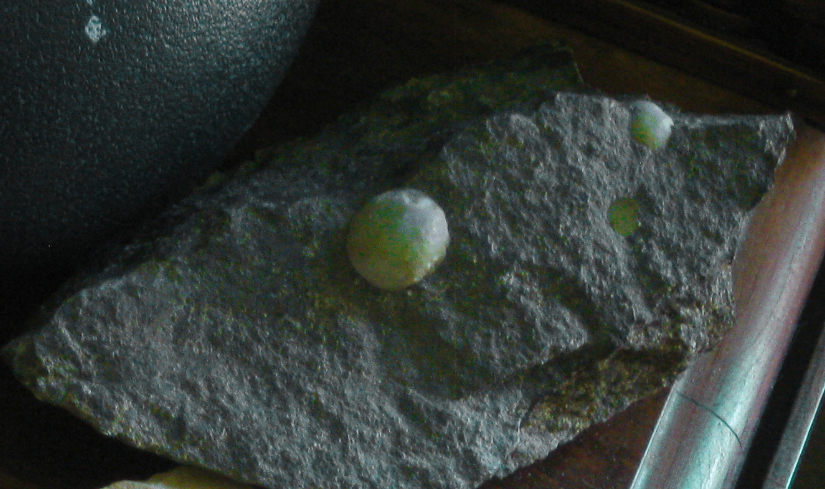
I have no idea when this guy was picked up. I know it is from the Oregon Coast (probably from Oceanside Beach) because I have found similar rocks there before... and that's where my family tends to go.... and I took it from my family. There's a tip right there: for ultimate cost savings, take things from family members. Not that my family really cared about this one pieces; they were glad that I wanted it. The outer stone matrix seems to be basalt and the agates are a lovely green quartz material (not sure exactly what, its a chalcedony, maybe chrysoprase).
This shell fossil was also from Oceanside beach. I love going to that beach in particular because just about everything turns up there: fossils, crystals, sea lions, etc. Anyway, this fossil made it onto the windowsill and I found it somewhat poetic to pose a carved serpentine bird next to it, looking on introspectively. I got the bird from a fantastic art show/installation of Zimbabwean stone sculptures in the Missouri Botanical Gardens a few years ago. Next to the bird is a little sand dollar on a stand and peaking out from behind the fossil is a tiger aloe, which I planted sans soil in a glass vase, suspended by reindeer moss and even more agates.
So start picking up more stuff! And watch out for spiders.
So let's finish up with some simple decoration. Using found objects always gives a space more individuality and more character. Picking up found, man-made objects almost always ends in tweezing out splinters and a tetanus booster. So I like picking up 'natural' objects. Although, this habit has resulted in plenty of contact dermatitis and a few nasty spider bites. But if you are doing anything in the arts, you are just asking for an increase in doctor visits anyway.
So this is what has happened to a dark, little, corner table. There is a Mother In Law's Tongue on the left, a little case in the back (it is housing my Play-Dough), a Cypraecassis rufa shell, an emu egg (received as a gift and made a tasty flan), agates in matrix, and two halves of a fossil.
I picked up the fossil on a rock hounding trip last summer. I was digging in several locations in Central Oregon and this guy was plucked out of the ground in the John Day Fossil Beds, near the Painted Hills. It has a conifer frond and a deciduous leaf. Definitely my favorite stone from that dig. The matrix is a very fragile mudstone, so cleaning isn't really possible. So there is the organic 'gunk' of root remnants still clinging to the surface. We'll just call it character.
I have no idea when this guy was picked up. I know it is from the Oregon Coast (probably from Oceanside Beach) because I have found similar rocks there before... and that's where my family tends to go.... and I took it from my family. There's a tip right there: for ultimate cost savings, take things from family members. Not that my family really cared about this one pieces; they were glad that I wanted it. The outer stone matrix seems to be basalt and the agates are a lovely green quartz material (not sure exactly what, its a chalcedony, maybe chrysoprase).
This shell fossil was also from Oceanside beach. I love going to that beach in particular because just about everything turns up there: fossils, crystals, sea lions, etc. Anyway, this fossil made it onto the windowsill and I found it somewhat poetic to pose a carved serpentine bird next to it, looking on introspectively. I got the bird from a fantastic art show/installation of Zimbabwean stone sculptures in the Missouri Botanical Gardens a few years ago. Next to the bird is a little sand dollar on a stand and peaking out from behind the fossil is a tiger aloe, which I planted sans soil in a glass vase, suspended by reindeer moss and even more agates.
So start picking up more stuff! And watch out for spiders.
Last of the rock links:
John Day Fossil Beds:
Painted Hills:
Missouri Botanical Gardens:
Sunday, August 5, 2012
Specimen Jewelry
The only thing better than jewelry, is jewelry that no one else has. And after people started wearing massive clocks as necklaces, it is getting harder and harder to be original. My strategy is to go with specimen pieces. The picture above is of three necklaces. The gray beads are labradorite, the interior green speckled beads are Chinese turquoise, and the exterior set of beads are chrysocolla. The first two I bought as strands and made them into necklaces, but the later was purchased from one of my favorite local makers/suppliers, Nature's Art. I really respect people who can make jewelry well. Honestly, it is one craft that I just never got that into. Not that I don't love it, it just never seemed to make it onto my list of skills to work on.
That being said, I did line up a new project for myself.
I just purchased this fantastic little ammonite fossil. Generally, most fossilized ammonites are just filled with agate-type crystals... but this one is filled with pyrite.
I have been loving these pyrite specimens since I saw some finished jewelry made from them about a year ago. Needless to say, my heart skipped a beat when I saw an opportunity to buy this guy (also from Nature's Art). These ammonites are unusual; the pyrite ones are only found in one deposit in Russia. So I guess I won't be picking them up on any walks any time soon.

The exterior of the shell is iridescent. It looks like it is made of actual nacre.
And there is already a hole in the center, so mounting should be a breeze.
Now I just need to figure out a mounting/wire wrapping, inevitably jury rigged solution. I really wish I had a better idea on what to do. I just feel bad covering up the fossil. I mean, that is the special part. Maybe a chain might just be the best option.
Kind of makes me want to buy more beads.
Some rock solid info (oh yeah, I went there):
http://en.wikipedia.org/wiki/Labradorite
http://en.wikipedia.org/wiki/Turquoise
http://en.wikipedia.org/wiki/Chrysocolla
http://en.wikipedia.org/wiki/Ammonite
http://en.wikipedia.org/wiki/Pyrite
Supplier of all things awesome:
http://naturesgifts4you.com/
Subscribe to:
Posts (Atom)